Natural language processing
Comparing models for mental-health text
We compared sentence embeddings, topic models, and clustering for a seven-label text-classification dataset.
The question
Would adding topic or cluster features improve on sentence embeddings alone? We compared those approaches using a public dataset of text labeled with mental-health-related categories.
What we did
- Prepared text and compared LDA topic features, TF-IDF-based clusters, and all-MiniLM-L6-v2 sentence embeddings.
- Trained logistic regression classifiers on each representation and on combinations of features.
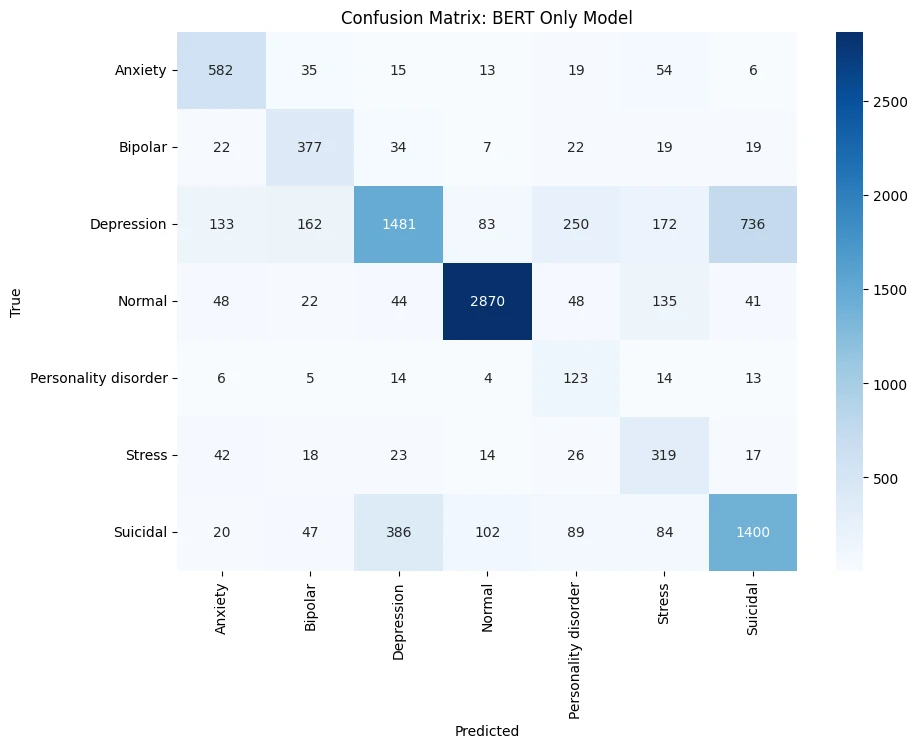
- Compared accuracy, macro F1, and per-class results on a stratified test split, including confusion matrices.
Results & discussion
In the saved run, sentence embeddings reached about 70% accuracy and 0.62 macro F1. Adding topic or cluster features changed those results very little. Performance varied considerably across labels, which was easier to see in the per-class metrics than in overall accuracy.
Limitations
These are dataset labels, not clinical diagnoses, and the project is not a diagnostic tool. Some unsupervised features were fitted before the train/test split; a stricter comparison would fit those steps on training data only. Class imbalance and the source of the text also matter when interpreting the results.
Team: Jordan Andrew, Aesha Gandhi, and Ammy Lin. Completed in December 2025. This repository is a fork of the collaborative project.
For the code and full project details, see the project repository.